
“The United States was founded on Christianity and should be a Christian Nation”
This idea is a common one, from the top all the way down. In Congress, Fine and Ogles are both in hot water for claiming Muslims don’t belong in American. Fine is Jewish and Ogles is a Protestant Christian…and a Christian Nationalist. They are also both, in my opinion, repulsive creatures who should be removed from congress for their anti-Constitutional views.
But that’s just my opinion.
Back to the facts, I want to answer the questions of whether Christians or Muslims are more likely to be radicalized, and what radicalization looks like in each religion. This is a timely topic, as Iran was an Islamic State, Israel is a Jewish State, and if some Americans had their way, American would be a Christian State.
Let’s start with assessing whether American was indeed founded as a Christian county.
George Washington and the Jews
Most people still think of the first settlement in the Americas being the one populated by the Pilgrims. That isn’t quite true, but since popular knowledge looks at this like the original colony, I’ll stick to the narrative. The majority of the Pilgrims who came over on the Mayflower were Christians, but not just any Christians. According to the Plimoth x Patuxet Museum, they were Separatists. After the establishment of the Church of England instead of the Roman Church, portions of England fractured into religious groups. Quote:
England was a Roman Catholic nation until 1534, when King Henry VIII (reigned 1509-1547) declared himself head of a new national church called the Church of England. Although he and his daughter, Queen Elizabeth I (reigned 1558-1603), changed some things that made the Church of England different from the Roman Catholic Church, a few people felt that the new Church retained too many practices of the Roman Church. They called for a return to a simpler faith and less structured forms of worship. In short, they wanted to return to worshipping in the way the early Christians had. Because these people wanted to purify the church, they came to be known as “Puritans.” Another group, considered very radical, went even further. They thought the new Church of England was beyond reform. Called “Separatists,” they demanded the formation of new, separate church congregations. This opinion was very dangerous; in England in the 1600s, it was illegal to be part of any church other than the Church of England.
And thus, the first colony created by the English in the Americas was a radical group of Separatists escaping religious persecution. The next group to arrive were the Puritans. More people arrived, settled, and eventually we had our thirteen colonies.
Eventually we got around to (understatement of the century, I know) the Constitution. This document created the core principles of the U.S., and is still used to this day to define rights and freedoms for Americans across the country.
So, was it a Christian document? No.
From Americans United, “The U.S. Constitution is a wholly secular document. It contains no mention of Christianity or Jesus Christ. In fact, the Constitution refers to religion only twice in the First Amendment, which bars laws ‘respecting an establishment of religion or prohibiting the free exercise thereof,’ and in Article VI, which prohibits ‘religious tests’ for public office. Both of these provisions are evidence that the country was not founded as officially Christian“.
You might say, “Okay, the Constitution didn’t outright say it, but it’s implied!”.
Also, no. When the first non-Christian establishment was erected in Newport, RI, George Washington himself wrote a letter to the Jewish Congregation stating:
“The Citizens of the United States of America have a right to applaud themselves for having given to mankind examples of an enlarged and liberal policy: a policy worthy of imitation. All possess alike liberty of conscience and immunities of citizenship. It is now no more that toleration is spoken of, as if it was by the indulgence of one class of people, that another enjoyed the exercise of their inherent natural rights. For happily the Government of the United States, which gives to bigotry no sanction, to persecution no assistance, requires only that they who live under its protection should demean themselves as good citizens, in giving it on all occasions their effectual support.”
TL;DR, anyone who lives by the laws of the land shall not face bigotry for their religious views. That’s coming from one of the Founding Fathers.
*eagle scream in the distance* (which is really a hawk scream but I won’t get on my soapbox about that right now)
So, America was not founded as a Christian Nation. Now that that’s sorted out, let’s learn about Christian Nationalism, the nu-radical flavor of Christianity.
Christian Nationalism and Rates of Adherence
Christian Nationalists believe, despite all evidence to the contrary, that the US was founded as a Christian Nation and should be a Christian State.
The Charles F. Kettering Foundation breaks down the 5 elements of Christian Nationalism as such (including why they are problematic):
A Desire for a Traditional Social Hierarchy: Basically, men lead their families while women support, same-sex marriage is wrong and there are only two genders. Quote, “Those who represent this ideal will enjoy easy access to the benefits of citizenship. Those who do not will be denied access. Nations that order their society accordingly will flourish. Those that do not will fall out of God’s blessing”.
A Commitment to Strong Ethno-Racial Boundaries around National Identity and Social Belonging: The belief is that white people founded the US, so white native-born people should be given privilege in the society. Having a hard time keeping my opinion of this take out of this post, so moving on..
Idealizing Free-Market Capitalism: “In response to fears surrounding “creeping socialism” around the New Deal, and later fears concerning communism, Christian leaders and wealthy capitalists promoted free-market capitalism, which emphasizes privatization, deregulation, and reduced public spending, as the Christian God’s preferred economic system.” This is weird because I distinctly remember Jesus feeding the hungry, healing the sick and clothing the poor. Which sounds kind of socialist to me. UGH these darn opinions keep spilling out of me! Next..
A Preference for Authoritarian Social Control: The general belief is that all chaos comes to a country when God-ordained hierarchies, boundary-lines and social systems are challenged. Quote, “Any nation that fails to abide by these ideals risks losing divine blessing. For this reason, strong rules and a strong ruler are necessary to bring order out of chaos. And because the stakes of a rightly ordered society are so high, nothing—not even democracy—can stand in the way”.
An Embrace of Populism, Perceived Victimhood, and Conspiratorial Thinking: “The populist impulse is the idea that this country was made for the common person and not for “elites,” who are constantly trying to steal away their birthright. This encourages a sense of victimization and persecution, which produces an affection for antiestablishment politics. These feelings of victimization and persecution also result in more conspiratorial thinking. Americans embracing Christian nationalism are more likely to endorse the Big Lie, question scientific findings, and believe the government is hiding secrets about various conspiracy theories”.
So, that’s Christian Nationalism. Basically, White, Straight, Native-Born US citizens will be given all the advantages and privileges many seem to think we already deserve, and everyone else will be locked out of society and told to obey.
Signs of radicalization exist in the news today, such as when U.S. Military Commanders told the troops under their command that the war in Iran was God’s Divine Plan and was meant to bring about Armageddon. One of the reports from a Commander said higher ups, “urged us to tell our troops that this was ‘all part of God’s divine plan’ and he specifically referenced numerous citations out of the Book of Revelation referring to Armageddon and the imminent return of Jesus Christ”. If a Christian can read that and not recognize that it is radical idealism, they could have just as easily been radicalized by Islam if they had grown up in that church.
Back on the topic of Christian Nationalism: How many Christians in America align with this viewpoint?
According to research by PRRI:
- 1 in 10 (10%) of all Americans are Christian Nationalist Adherents
- 2 in 10 (20%) of all Americans are Christian Nationalist Sympathizers
- Among Republicans Only, 20% identify as Christian Nationalist Adherents and 33% identify as sympathizers
- Among Democrats Only, 5% identify as Adherents and 11% identify as sympathizers
- The majority of Christian Nationalism Adherents (67%) and nearly half of Sympathizers (48%) agree that God ordained Trump to be the winner of the presidential election
- The majority of Christian Nationalism Adherents (68%) and Sympathizers (62%) believe that immigrants are invading our country and replacing our cultural and ethnic background
Overall, roughly 30% of this country either directly supports or is sympathetic to the cause of making American a Christian State. How does that compare to radical Islam?
Good, recent data that specifically targets how Muslims in the U.S. feel about radical groups was hard to find. Pew Research from 2015 found the following:
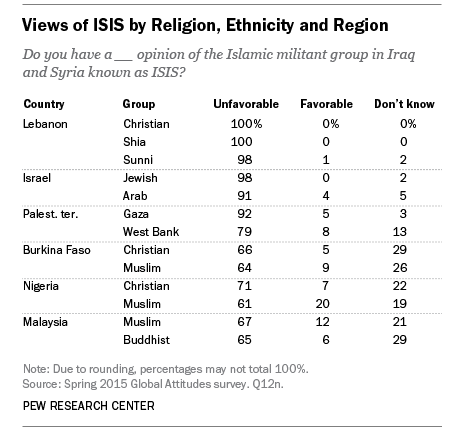
This can be summarized as “most Muslims who know enough to form an opinion have an unfavorable view of ISIS” – in other countries. We can guess that this is the same in the US, as the countries polled were Muslim majority. The data is old, so that needs to be considered.
To frame it a different way, I looked for data to see how many Muslims in the U.S. would like to see Sharia Law replace our legal system.
I found another old source from CATO, analyzing how U.S. Muslims feel about certain aspects of their religions. The findinds are:
- 37% of Muslims in the U.S. as of 2016 thought Sharia should be a source of legislation (not necessarily the sole source)
- 2% of Muslims in the U.S. held a favorable view of Al-Qaeda in 2011
- 13% of U.S. Muslims thought suicide bombing or other violence against civilian targets was justified to protect Islam
2017 Pew Research into American Muslims found the following:
- 73% of U.S. Muslims reported little to no support for extremism among their peers, while 11% reported a fair amount and 6% a great deal
- 76% say killing civilians to defend Islam is never justified, 8% said rarely, 12% said sometimes, and 5% said often.
How do those last findings on violent tactics compare to the general public in America? When asked the same questions as above, replacing the questions of “in the name is Islam” with “In the name of political, social or religious causes” the general public answered like this:
- 59% said it’s never justified, 24% said it’s rarely justified, 11% said sometimes, and 3% said it’s often justified.
So, your average American is more likely to support using violence for political, social, or religious causes than your average American Muslim is to support Jihadism.
Additional research in 2022 on the Capitol Riot attacks found that 17.7% of White, weekly churchgoers said that the riot was justified. This infers that White Christians who attend church think political violence, like the Capitol Riot, is acceptable if the cause is “worthy” (to them, not to me).
I truly wish I could find more recent data on these causes, but there just isn’t any out there for the public’s consumption. I even scoured the NYU Library of Resources for other grad student’s works and came up empty. I wonder why no one is studying this?! My tin foil hat brain says maybe because the evidence shows that Islam is no more likely to be used radically than Christianity, so research is being covered up.
Unfortunately, I don’t think choosing a thesis in Islamic Studies would work for my Cybersecurity degree, so it’s not something I can solve for.
Conclusion
The lack of recent studies was a huge hurdle to this research. As of 2017, Muslims in the U.S. were actually less likely than the general public to accept violence for their personal cause.
No evidence exists of a large movement of Muslims seeking to make American an Islamic State, though plenty exists that show Christians want to make it a Christian State.
I believe these findings show that Christians are just as likely as their Muslim counterparts to hold radical ideals. The difference is, many Christians DO want to impose theirs on all citizens. Muslims DON’T.
Last words – all religions deserve protection. If their “religion” forces them to commit a crime, that’s not a religion. It’s a facade.
Thanks, as always, for reading!


 Miss Information
Leave a reply to Hannah Krebs Cancel reply