
I’m Pro-Choice – What Does that Really Mean?

“The left wants to allow abortions up to 28 days after the baby is born!!”

Abortion is a tough topic to talk about.

It’s emotionally charged. We are biologically programmed to love and protect our young, so it’s completely understandable that people will have big opinions on the subject. Without a doubt, this is the most difficult post I’ve written to date, simply because of all the research I read talking about pregnancy loss, babies born with horrific disabilities, and the like.

What I wanted to do it research how most pro-choice people view abortion. Do most people feel abortion is always an option, no matter the age and health of the fetus? Or is there more of a grey area?

My Personal Story and Opinion

I personally don’t think I could have an abortion of a child conceived without violence being involved. I have two of my own beautiful kids, and I can’t imagine making the choice to end the life of one of their siblings. That being said, 1) I have been married and monogamous for almost 9 years, 2) I could afford another kiddo and 3) I can afford genetic testing that would inform me of any potential disabilities my fetus may have.

Both my husband and I have birth control methods. I take the pill, mostly for PMDD reasons, and he got the ole’ snippy snip. If we were to get pregnant now, it’d be a damn miracle and I’d respect God’s will. 🙂 We will, however, do whatever we can to prevent one.

Between our two kids, we experienced two miscarriages. One at 9 weeks, then another at 5. The first had to be helped along with mifepristone. The second resulted in a missed miscarriage, forcing me to choose a D&C over the chance of sepsis. These are both forms of abortion care.

During my pregnancy with my second kiddo, I developed cholestasis and had to go in just about daily for fetal monitoring. Mila was born 4.5 weeks early, 1.5 weeks before our scheduled induction. Luckily, she didn’t need any NICU time, and I had received a steroid shot to help develop her lungs since I had been going in and out of labor for over a month. This experience made us decide that another baby isn’t in the cards for us, as cholestasis almost always impacts future pregnancies.

I wanted to share this information as it’s important to know I’ve had my own experiences with birth control and abortion care. With that background, I will look into the research of how people view abortion rights statistically.

Being Pro-Choice OR Pro-Life is a Sliding Scale

On one end of the spectrum, there are people who say abortion is NEVER permissible, regardless of the pregnancy’s potential outcome for the mother. If the delivery will kill the mom, people in the camp of extreme say “so be it”.

The other side of the spectrum is those who will advocate for infant euthanasia after birth when permissible disabilities exist. If you want to read research on this, it’s here. I read it and it made me feel sick. At the risk of being called woke – trigger warning.

Where do most Americans fall? Gallup research has some interesting insights. According to Gallup, circumstances are important when it comes to abortion.

The split of circumstances looks like this:
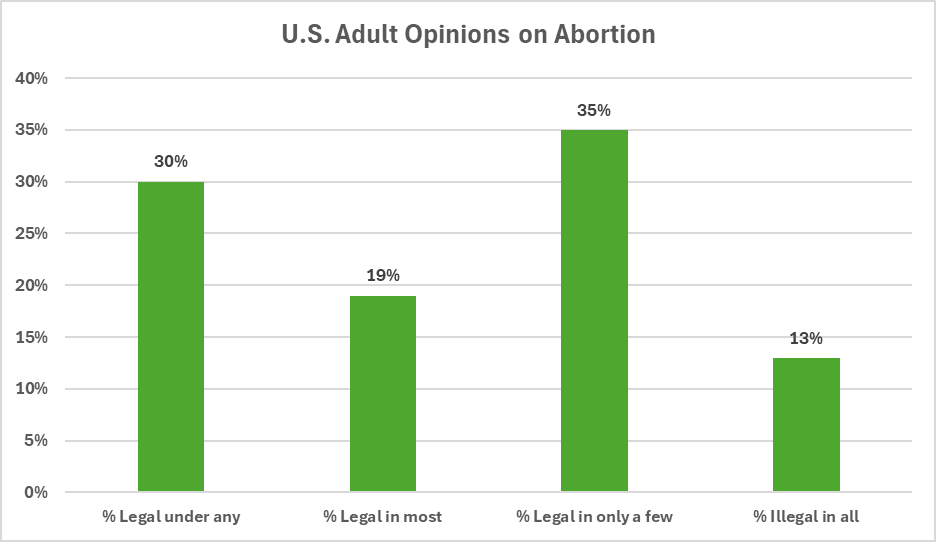
All but 13% of Americans agree that abortion should be legal in some circumstances. 30% of Americans think abortion should be legal ALL the time, whereas 54% see the legality is circumstantial.

The trimester also makes a difference for Americans. 69% of Americans supported abortion during the first trimester, whereas only 37% support in the second and 22% in the third. 59% of Americans disapprove of laws that ban abortions after a fetal heartbeat can be detected, usually around the sixth week of pregnancy.

So, there are the numbers. Americans as a majority support abortion in one situation or another, primarily if this happens in the first trimester.

Next question, what are the current routes for obtaining an abortion? What are the different flavors of laws out there?

Medical vs. In Clinic Abortions and State Laws

According to Planned Parenthood, the abortion pill (mifepristone or misoprostol) is only available until 77 days after the start of the woman’s last period. It is highly effective at ending pregnancies, even up to the cut-off number of days.

The alternative offered by Planned Parenthood is the in-clinic abortion. The length of time this choice is available is governed by state laws and by the clinic themselves. Some clinics will cut off before state laws mandate that they do.

According to AbortionFinder.org, laws break down like this:

  • 13 states completely ban abortion
  • 27 states ban abortion after a specified point in pregnancy
  • 9 states require a person seeking an abortion to wait a specified period of time before their abortion
  • 24 states require some type of parental involvement for a minor to get an abortion

Minnesota, the state where I live, allows abortions regardless of the length of the pregnancy, and does not require parental involvement for minors to get an abortion. Again, that’s what the state offers, not what clinics actually do. Planned Parenthood in St. Paul offers In-Clinic abortions up to 23 weeks and 5 days into the pregnancy.

Other states like Connecticut allows for abortions before the fetus would be viable outside the womb. Iowa and other states opt for a 6 week limit for legal abortion. As you can see, laws are all over the map!

Conclusion

Now for the part where I get to go off the rails and tell you my opinion.

I don’t support abortion without a clear medical reason past the first trimester. This is because it allows enough time for the family to get genetic testing to see if they have a healthy fetus, the fetus is not fully developed, and it is plenty of time for a young woman to decide if her pregnancy is right for her. If mom is in danger or the infant will not survive outside the womb, I support the rights of the parents to choose to have an abortion later than the first trimester. Those are the clear medical reasons I speak of!

That being said, it’s really not my business to tell another woman what she can and can’t do with her body. Having been through a pregnancy loss, I can tell you the decision to seek abortion care is not one that is undertaken lightly.

In addition, I think access to birth control is vital for preventing unplanned pregnancies where the mother may choose to abort her baby. If she has access to preventative medication, she’s more empowered to make her choices. Kids are gonna do what kids are gonna do, and I’m not naive enough to think abstinence works.

I hope it’s clear that not all pro-choice people are out there advocating for late term abortions. We as Americans mostly fall somewhere in the middle of the spectrum in a “yes, but…” situation.

Thanks for reading!

14 responses

  1. Sharing your story is not only brave, but also provides solid foundation for your perspective. As a realist, I recognize that any “ban” on abortions just means that the “choice” part of pro-choice gets more complicated/expensive/risky. If someone is determined to get an abortion, they will always have options.

    Like you, I can’t imagine making that decision lightly and as such, I support efforts to ensure that women understand all of their options as well as the long-term implications of each. None of the options are void of a financial, social, and/or psychological downsides.

    As a bit of an aside, we hear about parental rights when the abortion issue involves minor children, but almost never hear about the rights of the father. I can’t imagine the heartbreak of having my child aborted without even being allowed to have input. I know the alterative to force a woman to carry a child that she doesn’t want to full term is unrealistic, but that doesn’t make that heartbreak any less.

    Long story short, the best decision around the abortion issue is to avoid having to make the decision. It’s 2026 and we still don’t have a male version of “the pill”? C’mon man!

    Like

    1. That is an interesting take on what the father’s rights should be when it comes to abortion. In a consensual relationship, I feel that father has as much of a right as the mother. It’s the mother’s body that will be growing and delivering the child, but I believe the father should have the right to advocate for full custody of his child after it’s born in lieu of an abortion. If the mom isn’t ready to raise a child, the dad should be able to step up but not expect support from mom if she would have chosen abortion.

      And yeah, still waiting on the dude pill! Unfortunately, testosterone blockers do have pretty damaging side effects for males, not that female hormonal birth control doesn’t have a whole slew of side effects.. Condoms are where it’s at for now!

      Like

  2. eaglegenerouslyd136c69f39 Avatar
    eaglegenerouslyd136c69f39

    You are suggesting that there is some point– a decision point, if you will– that should mark the point at which “pro-choice” must end and “pro-life” becomes the law, with minimal exception, namely the life and reproductive health (not mental health as the radical pro-abortionists insist) of the mother. Fortunately, we have two great definitions of that point.

    The first is Roe v. Wade, which allowed states to regulate after fetal viability, generally considered 20 weeks. The second, and the one I really like, comes from a judge in South Carolina, who ruled that at 20 weeks, there is another person involved, and that by NOT seeking an abortion, the woman had taken an implicit contract to carry the child to term (again, absent a threat to herself). To me, abortion beyond that point of fetal viability SHOULD BE illegal. That it is not, in some states like MN, is to me a horrible assault on the idea of sacred human life and diminishes us as a whole society.

    That said, I know a lot of pro-life people, including more than a few who insist “human life begins at conception” and it is very hard to argue with that– it’s science. And since taking a human life is murder, they want all abortions, or at least those with a heartbeat, banned by law. It makes sense. I even buy the argument that it is “too easy,” that not all struggle with the decision as you may have, and that abortions take place as a substitute for birth control, for economic reasons, as an excuse for unprotected sex, or even for sex selection of the child (like in China).

    Since Roe v. Wade was overturned (and never really observed properly, IMHO), we have too much uncertainty in what the “right” law should be, what we SHOULD be writing into law. Its overturning means the states can sort it out, as it should have always been. Still, it is sorting itself out naturally, where permitted, in that Abortions occur (from AI): 40.2% at ≤6 weeks, 38.4% at 7–9 weeks, 14.2% at 10–13 weeks, 3.0% at 14–15 weeks, 1.6% at 16–17 weeks, 1.5% at 18–20 weeks, 1.1% at 21+ weeks; and abortions after 28 weeks are extremely rare. I knew it was something like that, but what I learned is that, even under a “heartbeat bill,” 40.2% of abortions could still be legal. And a ban after 20 weeks (Roe v. Wade) would end only 1.1% of legal abortions, probably less if the LOTM exception were allowed as it always is.

    So, yes, some middle ground is fine with me, but I think it needs to be coupled not with law, but with some rebirth of common-sense morals. I’m not buying “Kids are gonna do what kids are gonna do, and I’m not naive enough to think abstinence works.” I believe it works every time it is tried, and the problem with that attitude is we are not expecting kids to TRY. When we teach sex ed in school these days, we teach, “Don’t have sex, but if you do, wear a condom.” Now which PART of that message do you think kids hear?

    Sorry, stream of consciousness there…

    Like

    1. We agree on a whole lot of things, it seems! Thank you for sharing the data of when most abortions occur, that was very interesting.

      On abstinence not working we differ. I was a teenager 15 years ago. My sex ed class was taught in Catholic School, and was very much just “Don’t have sex, ever, or God will hate you”. I believe every single one of my classmates was sexually active before turning 18, despite being taught abstinence in practicing Catholic homes. I think teaching safe sex practices to kid is vital, because assuming any percentage of them would choose to be sexually active, they need to know how to be safe about it.

      Like

      1. eaglegenerouslyd136c69f39 Avatar
        eaglegenerouslyd136c69f39

        not everybody goes to a Catholic school or is brought up by strict Catholic parents. And even though they are not, premarital sex among teenagers is now on the decline simply because they have gotten the message, maybe, or because they have better things to do, maybe? At any rate about half of kids will experiment by age 18 but only about half remain sexually active. And that is even with, as I am convinced, the public schools continue to put out that mixed message of don’t but if you do.

        And even the results have changed. There was a time in which 70%, IIRC, of all teen pregnancies ended in abortion. Now, IIRC, that is almost reversed and 70% result in birth. I am almost tempted to include the trite but correct bumper sticker slogan,*pro-choice before conception, pro-life after.”

        Like

      2. I’m curious where you found those statistics? I’d really like to dig into the research on that!

        Like

      3. eaglegenerouslyd136c69f39 Avatar
        eaglegenerouslyd136c69f39

        Heh. You and I differ in what we consider sources of information. Lately I have been asking AI some of those questions, but then I crash the answer against my own experience, knowledge, and maybe simple logic. I didn’t do that here. The numbers (remember, IIRC) came from a social worker who came to the high school Sunday School class I was teaching. That’s it. Teen pregnancies used to end up in the Florence Crittendon Home, or “visiting her Aunt Harriet.” Then times changed and abortion on demand came along, swinging the statistics in THAT direction, and finally, teen pregnancy became more or less socially acceptable, and young women kept the child. It made sense. If you can find real numbers, fine.

        I’m fascinated by the “liberal prism” through which you view the obvious facts. Nobody hates women or children, but it makes terrific emotional blackmail for political purposes. Some would call it slander. Rolling back programs that are not effective, or that are riddled with fraud, waste and abuse, is NOT “refusing aid,” but HELPING those in true need. And it should start with making FATHERS responsible for their children. Joseph was, and he even had an excuse.

        Finally, let us give up that tired old “separation of church and state” canard. There is no such thing in our Constitution. So while the State should not meddle in the Church, the Church MUST influence the State, to make the State responsive to the “morality” of the society it governs. If Walz wants to pay for abortions, he should also be funding the alternative. I’m surprised that you see a role for the State in this decision, and then won’t allow one of the alternatives. I’m also surprised that you think the Church should be responsible for this particular alternative, but refuse to redirect government spending to fund the Church alternative to all kinds of welfare spending.

        Like

      4. The fact is that the majority of households using SNAP, Medicaid, etc. are US-born households, not immigrants. Cutting off funding rather than investigating fraud while continuing the program is what makes it appear, from the outside, like leadership does not care about families. I agree that fathers should pay for their kids, and they typically do. There are exceptions – my own brother was arrested on the way to my wedding for not paying child support. So, it’s also true that fathers not paying can be found criminally and civilly liable. I wouldn’t call my views as filtered through a liberal prism, as I base my opinions on the facts. I can find you data to support everything I just claimed, and that data wouldn’t be a CNN article.

        The only mention of religion in the Constitution is the in the First Amendment which gives freedom of religion, and Article IV which prevents religious tests for government seats. Morality does not come from religion, it comes from a person’s own choices. To say that you can’t be a moral person without a religious faith is incorrect: if you need God to tell you to be a decent human, you’re not a decent human. Walz isn’t out there paying for abortions, he’s paying for legal medical care, which abortion falls under. Also note, Medicaid is federally funded. Minnesota pays into it as well, but the majority of the money comes from the feds. Let’s say Medicaid is used to pay for chemotherapy for someone with cancer, or psychiatry meds for someone with schizophrenia. Should Medicaid also pay for alternative medicines to treat those conditions? Should Medicaid fund herbal teas that are said to cure cancer, despite research showing it absolutely doesn’t? Should Medicaid fund psilocybin treatment as it’s been found to effectively treat mental illness but requires taking a hallucinogenic drug?

        Like

      5. eaglegenerouslyd136c69f39 Avatar
        eaglegenerouslyd136c69f39

        We really need a “germane” proviso for the comments. About your latest.

        Nobody said anything about immigrants receiving welfare, so if they are that’s misuse, and they shouldn’t be receiving it all under the legal requirement to “not be a burden.”

        “Cutting off funding rather than investigating fraud while continuing the program… does not care about families.” Except that the State is responsible for qualifying recipients and what should be the penalty for not doing the job? Yes, it’s unfortunate, but how many real families suffer because fraudsters used up the money?

        “I agree that fathers should pay for their kids, and they typically do.” So why are 70+% of black kids born out of wedlock and raised with “no father”? There was a law proposed a while back that would require mothers to name the father at childbirth, to make him responsible. Democrats defeated that law.

        “I wouldn’t call my views as filtered through a liberal prism, as I base my opinions on the facts. I can find you data to support everything I just claimed,” This is something I have been trying to understand for years. How people can look at the same set of facts and reach distinctly different opinions as to what those facts mean. I laugh at educators claiming they are teaching “critical thinking skills” while teaching only “facts” that support one side of contentious issues, while critical thinking requires a broad range of knowledge and experience against which new “facts” can be judged, which kids do not have. And of course, that experience DOES bias our interpretation of new facts, it’s called “confirmation bias” and there is almost nothing we can do about it.

        “The only mention of religion in the Constitution is the in the First Amendment which gives freedom of religion, and Article IV which prevents religious tests for government seats. Morality does not come from religion, it comes from a person’s own choices.” I disagree. You may not have to belong to a particular religious denomination or sect, but there are “eternal standards” of behavior recognized by most religions and that SHOULD be followed, if not by law by self-governance. You are talking about “situational ethics” and that way lies chaos. Society must have “mores” or we cannot live together.

        “Walz isn’t out there paying for abortions, he’s paying for legal medical care, which abortion falls under.” We are having that discussion elsewhere. If it were NOT legal, would Walz still insist on paying for it? And if it were legal but not moral, should the State be doing something immoral?

        “Also note, Medicaid is federally funded. ” What does that have to do with anything? If tax money is being misused, I don’t care which of my pockets it came out of. Or let me have it and I will find something good to do with it.

        Like

      6. Immigrants become eligible for federal welfare when they become lawful permanent residents. Why would we ask people who are new to a country, don’t speak the language, and may or may not have their professional degrees to do something that not every household with a family who was born here can do?

        The state is responsible for qualifying recipients, and the guidance for that is created at the federal level – they aren’t optional requirements. Referring to my previous research into overpayments for ABA, the problem is not with the people qualifying, it’s with providers. It’s with documentation and post-payment reports, which is not a problem unique to Minnesota. Why, then, is only Minnesota having funding cut?

        On the unwed mother birthrate and single parenting, that’s a cultural issue and not a legal one. Factors like access to contraceptives, poverty, and education factor into these metrics. The issue with making a mother claim a father on the birth certificate isn’t a legal one either, it’s a moral one. It’s up to the mother if she wants to claim the father, and there are good reasons why she may not want to.

        As far as the prism issue goes, I can only use the facts that I find. If you present well-researched facts to the contrary of my argument that aren’t easily explainable, I’m happy to consider them. Take the rate of unwed mothers as an example – both Hispanic and Black mothers are more likely to have babies out of wedlock. Asian folks are the lead likely, followed by White folks. Notice the difference there? Two groups have brown skin and historically have faced more challenges because of their skin color than Whites and Asians.

        Basic morality is something we already uphold in our laws. No murder, no rape, no robbery, etc. Where I draw the line is when our own morals cloud our judgement of what other people should be doing. Abortion is legal, and if your concern for babies being born is so important, then you’d need to support a mother who would have chosen abortion getting a free ride if she chooses to keep her baby. Including a nanny, night nurse, etc. That’s gonna get expensive, and regardless, not every woman has a choice in becoming pregnant in the first place. Since pro-life people tend to be more religious, why wouldn’t the Church be willing to uphold their moral views by spending their own money on these initiatives?

        If abortion were illegal, women would be getting back-alley care elsewhere, leading to complications like infection or even death. As we have seen with states banning abortion, self-funded groups do step up to transport women out of state to get abortions. Again referring to the amorality of abortion, I don’t think any woman feels great about her choice to abort. She is choosing what is right for her, and that might not be bringing a kid into the world in poverty and instability. She could adopt her kid out, and they may grow up in an abusive and neglectful system. A system that now gets less funding than it ever has. Do you think she’d feel good about that?

        Pointing out the funding source for Medicaid is important because it’s not just that Minnesota has decided abortion is fine. The feds have, thus they allow their money to pay for abortions.

        Like

  3. clearlytidalwaved54c9b493e Avatar
    clearlytidalwaved54c9b493e

    I voted a straight Republican ticket for most of my adult life—basing my decision on the issue of abortion. I believed Republicans were the party of pro-life, and for some reason, that’s all that seemed to matter to me. But in all those years, I never once put myself in the shoes of a young single woman with no support system who found herself pregnant. It was an eye-opening exercise.

    Conservative politics lost me when we went into Iraq in 2003, but I still felt beholden to the party for its supposed pro-life ideology. It took me a fair amount of soul-searching before coming to understand that I have no business in how someone chooses to proceed when faced with an unexpected pregnancy. It’s none of my business—especially if I’m going to do nothing to help the woman out.

    It was also around that time that I came to realize I had been used by the GOP for my pro-life sentiments. I stopped allowing the issue of abortion to sway my vote because those who claimed to champion that cause did little to help sustain the lives they claimed to want to protect once they were born. It has only become even more evident in subsequent years that I was right in my decision to leave the party over this issue. Massive cuts to programs for the most needy among us to pay for tax cuts for the most wealthy among us in the One Big Beautiful Bill is but one glaring example.

    Thank you for your reasoned words on the matter. I recently stumbled onto your blog.

    Liked by 1 person

    1. Thank you so much for sharing your story and perspective! I especially enjoyed this sentiment: “I stopped allowing the issue of abortion to sway my vote because those who claimed to champion that cause did little to help sustain the lives they claimed to want to protect once they were born”. Cuts to Medicaid, SNAP and other life-sustaining programs really do show how the GOP uses the pro-life ticket to get votes – not because they care about our children.

      Thank you so much for reading, I hope you stick around!

      Liked by 2 people

      1. eaglegenerouslyd136c69f39 Avatar
        eaglegenerouslyd136c69f39

        I am increasingly outraged by people telling me what Republicans think. I am a Republican and have only voted for a Democrat once in my life and that was a mistake. I have accepted that I am part of a party who believes sacred human life begins at conception and reject the notion that a human life can be terminated because it is inconvenient or to cover up a poor personal choice.

        most of all I am outraged by the notion that Republicans either hate women because they will not allow women to kill their unborn children, or that we hate children because we do not want them killed. Thus I was really outraged when Tim Walz and the DFL cut off funding for the pregnancy resource centers in Minnesota – the true operation providing choice to pregnant women. There are all manner of these organizations for unintended pregnancies. And to suggest that cutting off fraud in programs to help the poor is equivalent to not wanting to help the poor is just backwards, for lack of a less pleasant word.

        Like

      2. I also feel that any claims that “All Republicans feel X or Y” or “All Democrats support A” are always a problem. When I say Republicans, I’m typically referring to Republican leadership. Not voters.

        The stigma of hating women and children seems to stem from the project 2025 guidance on attacking women’s rights to abortion and contraception, including legally penalizing a woman for seeking an abortion. They idea of hating children comes from plans to roll back programs like Head Start, SNAP and Medicaid funding. I don’t think you can make a woman carry and raise her child but then refuse aid that would help her feed, house and clothe her child.

        When Tim Walz cut funding, it was to the Positive Alternatives Grant, which was a Conservative Christian-backed program that sought to dissuade women from having an abortion. Many pregnancy clinics had come to rely on that funding and thus there was a panic when funding ended. My feeling is that law and religion need to remain separate. Abortion is legal, and if the Church wants to offer aid to women to dissuade their decision the church could fund these programs themselves.

        Like

Leave a comment

About the author

Hannah is a cybersecurity expert, Master’s degree Student and a freelance blogger with a passion for finding the fact and fiction behind political debates and hot-button issues. This blog is a passion project, and anyone learning anything from it is just a bonus. The author feels that anyone can literally say anything; what matters is what they can prove.

Get updates

Spam-free subscription, we guarantee. This is just a friendly ping when new content is out.