“Trump isn’t starting a new war with Iran – he’s finishing one that’s been going on for 47 years!”
Trump ran on a campaign of being anti-war. “No new wars!” was a key pillar of his 2024 campaign, and that really resonated with Americans. Over the two-decades long war in the Middle East, many people either fought or loved someone who fought in the “War on Terror”. The trillions of dollars really got us nothing. We successfully destabilized an entire country, then spent the rest of the time trying to figure out how to leave with “western-friendly” leadership in place.
I was enlisted during this time. People nearing retirement had been deployed to the Middle East after 9/11, then repeatedly throughout the years to fight the same war with no resolution in sight. There was a great deal of animosity about this among the SNCOs.
Now, Trump is bombing Iran. Calling it a war, without Congressional approval. Stating, “The lives of courageous American heroes may be lost, and we may have casualties. That often happens in war“.
I want to look into the history of our relationship with Iran, the reasons we are engaging them, and the rumors surrounding the whole affair.
As always, we are going to start with the history.
The U.S. and Iran
I’m sourcing the history from the Council on Foreign Relations‘ assessment of U.S. Relations with Iran. I’ll be presenting this in timeline format and will basically copy/paste it to not miss any details.
1953: U.S. and British intelligence agencies help elements in the Iranian military overthrow Iran’s prime minister, Mohammed Mossadeq. This follows Mossadeq’s nationalization of the Britain-owned Anglo-Persian Oil Company, which led London to impose an oil embargo on Iran. The coup brings back to power the Western-friendly monarchy, headed by Shah Mohammad Reza Pahlavi. Deeply unpopular among much of the population, the shah relies on U.S. support to remain in power until his overthrow in 1979.
1954: Under U.S. and UK pressure, the shah signs the Consortium Agreement of 1954, which gives U.S., British, and French oil companies 40 percent ownership of the nationalized oil industry for twenty-five years.
1957: The United States and Iran sign the Cooperation Concerning Civil Uses of Atoms agreement as part of President Dwight D. Eisenhower’s “Atoms for Peace” initiative, under which developing countries receive nuclear education and technology from the United States. It lays the foundation for the country’s nuclear program, and the United States later provides Iran with a reactor and weapons-grade enriched uranium fuel. Their collaboration continues until the start of Iran’s 1979 revolution.
1960: Iran, Iraq, Kuwait, Saudi Arabia, and Venezuela establish the Organization of the Petroleum Exporting Countries (OPEC) to rival the mostly Western companies dominating global oil supplies and to reestablish control over their domestic oil reserves. By the 1970s, OPEC profits skyrocket and the group gains considerable leverage over Western economies. Iran’s increased market clout makes it an even more crucial U.S. ally.
1972: President Richard Nixon travels to Iran to ask the shah for help protecting U.S. security interests in the Middle East, including by opposing a Soviet-allied Iraq. In return, Nixon promises that Iran can buy any nonnuclear weapons system it wants. Oil prices skyrocket amid the 1973 Arab-Israeli War and the subsequent Arab oil embargo against the United States, allowing the shah to purchase a larger supply of high-tech weaponry than anticipated, which unsettles U.S. officials.
1979: The shah flees amid widespread civil unrest and eventually travels to the United States for cancer treatment. Grand Ayatollah Ruhollah Khomeini, a Shiite cleric who opposed the shah’s Westernization of Iran, returns to the country after fourteen years in exile. Khomeini takes power as the supreme leader in December, turning Iran from a pro-West monarchy to a vehemently anti-West Islamic theocracy. Khomeini says Iran will try to “export” its revolution to its neighbors. In 1985, the militant group Hezbollah emerges in Lebanon and pledges allegiance to Khomeini.
1979-1981: A group of radical Iranian college students takes fifty-two Americans hostage at the U.S. embassy in Tehran, demanding that the United States extradite the shah. Washington severs ties with Tehran, sanctions Iranian oil imports, and freezes Iranian assets. After 444 days, the hostages are released under the Algiers Accords [PDF], which were signed just minutes after the inauguration of President Ronald Reagan, whose 1980 presidential campaign emphasized President Jimmy Carter’s failure to free the hostages. As part of the accords, the United States promises not to intervene in Iranian politics.
1980-1988: Iraq invades its neighbor and growing rival Iran amid fears of a Shiite revolt against Iraqi leader Saddam Hussein. The United States supports secular Iraq with economic aid, training, and dual-use technology until the war ends in 1988, even after the CIA finds evidence that Iraqi forces used chemical weapons against Iranians. An estimated one million Iranians and 250,000–500,000 Iraqis die in the conflict.
1983: Two trucks loaded with explosives drive into barracks housing American and French service members of the Multinational Force in Lebanon, then detonate. The attack kills 241 U.S. military personnel—the highest single-day death toll for the U.S. Armed Forces since the Tet Offensive during the Vietnam War. A group named Islamic Jihad, widely believed to be a front for Hezbollah, claims responsibility for the attack. The bombing hastens the withdrawal of U.S. marines from Lebanon, and leads the State Department to designate Iran as a state sponsor of terrorism in 1984.
1985: Despite an arms embargo, senior Reagan administration officials begin secretly selling weapons to Iran to secure the release of seven Americans held hostage by Hezbollah in Lebanon. The officials use the money from the illegal deal to fund the right-wing Contras rebel groups in Nicaragua after Congress prohibits further funding of the insurgency. Reagan takes responsibility for the scandal in a 1987 televised address, and the affair ends in some officials’ convictions. Hezbollah kills two of the hostages and releases the others over several years.
1988: After an Iranian mine nearly sinks an American frigate in the Strait of Hormuz, the U.S. Navy launches a retaliatory campaign called Operation Praying Mantis. American forces destroy two Iranian oil platforms and sink a frigate. In July, the U.S. Navy shoots down an Iranian passenger jet after mistaking it for a fighter jet, killing all 290 people on board.
1991: The United States leads a coalition of thirty-five countries to expel Iraqi forces occupying Kuwait, ousting the Iraqis in a matter of months. The war leads to intrusive UN inspections to prevent Iraq from restarting its weapons of mass destruction (WMD) programs. Comprehensive sanctions and widespread corruption under the Oil-for-Food Program, created in the wake of the war, devastate the Iraqi public for nearly a decade, but fail to dislodge Saddam. Iran declares its neutrality in the conflict, but U.S. officials suspect it seeks to replace Iraq as the dominant power in the region.
1992-1996: The United States ramps up sanctions against Iran under the George H.W. Bush and Bill Clinton administrations. In 1992, Congress passes the Iran-Iraq Arms Nonproliferation Act, which sanctions materials that could be used to develop advanced weaponry. The White House expands sanctions with a complete oil and trade embargo in 1995. The 1996 Iran and Libya Sanctions Act imposes an embargo against non-American companies investing more than $20 million per year in Iran’s oil and gas sectors.
1998-2000: Secretary of State Madeleine Albright meets with Iran’s deputy foreign minister at the Six-Plus-Two talks during the 1998 UN General Assembly. It is the highest-level U.S.-Iran contact since 1979. In April 2000, Albright acknowledges the United States’ role in overthrowing Mossadeq and calls previous policy toward Iran “regrettably shortsighted,” although the United States does not explicitly apologize for the intervention. Some sanctions against Iran are lifted.
2001: After the 9/11 terrorist attacks, President George W. Bush’s administration establishes a back channel with Iran to help coordinate the defeat of the Taliban, a shared enemy that had provided safe haven to members of al-Qaeda in Afghanistan. In the aftermath of the 2001 U.S. invasion of Afghanistan, the United States and Iran collaborate on the Bonn Agreement [PDF] regarding state-building and the repatriation of Afghan refugees.
2002: During his 2002 State of the Union address, President George W. Bush describes Iran as part of an “axis of evil,” along with Iraq and North Korea. He says Iran “aggressively pursues [weapons of mass destruction] and exports terror, while an unelected few repress the Iranian people’s hope for freedom.” In response, the Iranian government stops secret meetings with U.S. diplomats that are focused on capturing al-Qaeda operatives and combating the Taliban.
2003: U.S. forces invade Iraq, aiming to end the threat posed by what Washington says are Saddam Hussein’s revived WMD programs. Iran backs local Shiite militias in Iraq, some of which participate in attacks on U.S. forces. Saddam’s dictatorship is toppled and he is executed in December. A 2019 U.S. Army study on the Iraq War concludes that “an emboldened and expansionist Iran appears to be the only victor” in the conflict.
2006: Iranian President Mahmoud Ahmadinejad sends President George W. Bush an eighteen-page letter—the first letter from an Iranian leader to a U.S. one since 1979. Ahmadinejad seeks to ease U.S.-Iran nuclear tensions, but Iran takes no steps to slow its uranium enrichment program, which it says is for civilian energy production. Separately, the U.S. Congress approves the Iran Freedom Support Act in September to fund Iranian civil society and promote democracy.
2007: During a speech at the opening session of the UN General Assembly, Ahmadinejad calls the dispute over Iran’s nuclear program “closed” and says his government will disregard Security Council resolutions calling on the country to halt uranium enrichment. At a press conference afterward, he calls the Israeli government an “illegal Zionist regime.” A U.S. National Intelligence Estimate [PDF] released in November finds that Iran ended its nuclear arms program in 2003 but continued to enrich uranium.
2013: President Barack Obama calls newly elected Iranian President Hassan Rouhani in September to discuss Iran’s nuclear program, the most direct contact since 1979. Two months later, Iran and the P5+1—the five permanent members of the UN Security Council plus Germany—sign an initial nuclear agreement [PDF], providing Iran with some sanctions relief. Obama praises the deal for cutting off Iran’s “most likely paths to a bomb,” while Rouhani hails it as a “political victory” for Iran.
2015: Iran, the P5+1, and the European Union reach an agreement on Iran’s nuclear program that is named the Joint Comprehensive Plan of Action (JCPOA). In return for sanctions relief, Iran agrees to undertake a series of steps, including dismantling and redesigning its nuclear reactor in Arak, allowing more intrusive verification mechanisms, and limiting uranium enrichment for at least fifteen years. The deal is meant to increase Iran’s “breakout time” for developing enough fissile material for a nuclear weapon from a few weeks to at least one year. Many Republican and some Democratic lawmakers oppose the deal, arguing that lifting sanctions will bolster the Iranian government and allow it to destabilize the region.
2018: President Donald Trump announces that the United States will withdraw from the JCPOA and mount a sanctions campaign to place “maximum pressure” on Iran. Many arms control experts and European allies condemn the move, while many Republican lawmakers, Israel, and Saudi Arabia applaud it. Iran responds by boosting uranium enrichment in defiance of the agreement’s terms. The withdrawal marks the beginning of rhetorical and military escalation with Iran under the Trump administration.
April 2019: Trump designates the Islamic Revolutionary Guard Corps (IRGC)—a branch of the Iranian army—a foreign terrorist organization (FTO). It is the first time the United States designates part of another country’s government as an FTO. A week earlier, Israeli Prime Minister Benjamin Netanyahu tweets that he personally requested the move. Rouhani says the action will only increase the IRGC’s popularity at home and abroad.
May- October 2019: On June 13, two oil tankers are attacked near the Strait of Hormuz, about a month after four commercial ships are damaged in the same area. The United States blames Iran for the attacks, with Trump calling the country “a nation of terror.” The United States announces the deployment of one thousand additional troops to the Middle East in response, and the IRGC shoots down a U.S. surveillance drone two days later. The United States again blames Iran for attacks on oil tankers in the region in the following months and tries to seize an Iranian vessel sailing near the British territory of Gibraltar.
September 2019: Drones attack oil facilities of state-controlled Saudi Aramco in eastern Saudi Arabia, striking the country’s second-largest oil field and a critical crude-oil stabilization center. The attack halts half the country’s oil output and causes an unprecedented jump in Brent crude prices. Trump approves the deployment of U.S. troops to bolster Saudi air and missile defenses at the kingdom’s request. Yemen’s Iran-backed Houthi rebels claim responsibility for the attack, citing Saudi intervention in Yemen’s civil war, but the United States and Saudi Arabia blame Iran.
December 2019: Iraqi demonstrators and Iran-backed militias attempt to seize the U.S. Embassy Baghdad in retaliation for an air strike that killed militia members. Protesters chant “death to America” and demand that the United States withdraw its troops from Iraq. In response, President Trump tweets that Iran will pay “a very big price” for any lives lost or damage incurred at U.S. facilities.
January 2020: The United States kills Qasem Soleimani, commander of the IRGC’s elite Quds Force, with a drone strike in Baghdad. Soleimani was considered by some experts to be Iran’s second most powerful person after Supreme Leader Ali Khamenei. Iraqi militia leader Abu Mahdi al-Muhandis is also killed, along with seven other Iranian and Iraqi nationals. Iran promises revenge and announces that it will no longer commit to restrictions under the nuclear deal. Soon after, Iran mistakenly shoots down a Ukrainian passenger plane as Iranian forces are on high alert for possible U.S. attacks. It later attacks multiple U.S. bases in Iraq, wounding dozens of U.S. and Iraqi personnel.
April 2020: Iran launches its first military satellite, prompting U.S. concerns over Iran’s long-range missile capabilities. Days later, U.S. Secretary of State Mike Pompeo says the United States is still party to the JCPOA and will seek to snap back multilateral sanctions against Iran through a Security Council resolution. Opponents of the move, including JCPOA signatory Russia, argue that the United States abandoned the terms of the deal when the Trump administration’s reimposed sanctions on Iran. Iranian boats threaten U.S. Navy vessels in the Persian Gulf, but the United States does not respond militarily.
May 2020: Amid a shortage in Venezuela, Iranian tankers arrive to deliver oil despite U.S. sanctions on both countries. In June, the White House sanctions five Iranian ship captains involved in the delivery to discourage trade between Iran and Venezuela.
October 2020-December 2020: The Trump administration seeks to extend a decade-long UN arms embargo on Iran that is set to expire in October under the JCPOA. The administration contends that Iran is in violation of the deal and cannot be allowed to replenish its weapons stockpile. At the UN Security Council, a U.S.-backed resolution to extend the embargo fails, highlighting a lack of international support for Washington’s Iran policy and the United States’ diminishing influence. The United States also fails in its attempt to reimpose international sanctions on Iran using the JCPOA’s “snapback” mechanism, leading it to unilaterally sanction entities previously targeted by the United Nations and say it will continue to abide by the now-expired UN embargo.
Trump ramps up his maximum-pressure campaign against Iran with a flurry of new sanctions targeting entities in the oil and financial sectors and a leading charity, among others, as well as top officials. Washington cites as reasons for the new measures the Iranian government’s alleged interference in the 2020 presidential election, its suspected development of chemical weapons, and human rights abuses committed during a crackdown on protesters in November 2019.
November-December 2020: Following the assassination of Mohsen Fakhrizadeh, a top nuclear scientist, Iran’s parliament approves a bill to boost uranium enrichment to 20 percent—far beyond the concentrations permitted by the JCPOA. It also vows to expel International Atomic Energy Agency inspectors if sanctions on the banking and oil sectors are not lifted within two months. The bill passes with approval from Supreme Leader Khamenei, despite President Rouhani’s opposition. Iran blames Israel for Fakhrizadeh’s killing, and hard-liners insist the United States was also involved. Khamenei signals that U.S.-Iran relations will still be fraught under President-Elect Joe Biden.
April 2021: The JCPOA’s signatories hold talks in Vienna aimed at bringing the United States and Iran back in compliance with the agreement. U.S. and Iranian officials attend the so-called proximity meetings to exchange ideas on sequencing a return to the deal. Each side insists that the other should be the first to resume its obligations, and they try to downplay expectations for immediate progress. The talks persist even after an explosion at Iran’s Natanz nuclear facility—which it blames on Israel—leads Iran to enrich uranium at a new high of 60 percent purity.
June-November 2021: In June, Iran’s presidential election is won by conservative cleric Ebrahim Raisi, a judiciary chief targeted by U.S. sanctions due to his involvement in a 1988 panel that sentenced thousands of dissidents to death as well as his role in the repression of Iran’s 2009 Green Movement protests. Negotiations to revive the JCPOA stall for months as Raisi completes his transition to power. The talks resume in November, with Iran’s new negotiators adopting a more hard-line stance compared to their predecessors’. Meanwhile, there are signs that the country’s uranium-enrichment capabilities are advancing.
March 2022: The United States, Bahrain, Egypt, Israel, Morocco, and the United Arab Emirates (UAE) establish the Negev Forum, a regional cooperation framework that aims to deter Iran, among other goals unrelated to defense. The same month, the United States secretly assembles military officers from Bahrain, Egypt, Israel, Jordan, Qatar, Saudi Arabia, and the UAE for a meeting focused on addressing Iran’s drone and missile capabilities.
March-July 2022: Negotiations on reviving the nuclear deal pause during Russia’s invasion of Ukraine and, when they resume in June, yield little progress. U.S. officials warn that time to save the deal is running out as Iran reportedly accumulates enough enriched uranium to fuel a nuclear bomb, though creating a functional weapon could take months or years. During his first visit to Israel as president, Biden commits the United States to using “all elements of its national power” to prevent Iran from acquiring a nuclear weapon.
September-October 2022: A wave of women-led protests roils Iran, with many demonstrators denouncing Supreme Leader Khamenei and calling for an end to the Islamic Republic. Security forces try to suppress the demonstrations, restricting internet and cellular service and arresting some 12,500 people. They kill over two hundred protesters. The Biden administration sanctions entities involved in the crackdown and exempts tech companies from other sanctions to help Iranians access the internet. Meanwhile, the White House signals that nuclear talks are indefinitely stalled due to the protests and Iran’s apparent support of the Russian invasion of Ukraine.
September 2023: Washington issues a sanctions waiver that frees up $6 billion in Iranian funds frozen in South Korea in return for the release of five Iranian American dual citizens detained in Iran. Republican lawmakers criticize the deal—said to be mediated by governments including Iraq, Oman, Qatar, Switzerland, and the United Kingdom—as a ransom paid to a hostile government. U.S. officials say the funds offer limited benefit to Iran, which can only access the capital indirectly and use it to buy humanitarian goods. Days later, Biden also grants clemency to five Iranians jailed in the United States, though only two plan to return to Iran.
October 2023: Iran-backed Palestinian militant group Hamas launches a surprise assault on Israel in early October that kills more than 1,300 Israelis, the country’s deadliest-ever attack on civilians. The group also captures dozens more Israelis as hostages. After the attack, the United States and Qatar cooperate to block Iran from accessing the $6 billion in humanitarian assistance released to it in September. U.S. and regional intelligence officials find no immediate evidence of Iran’s direct involvement in Hamas’s offensive, but experts say the country had provided weapons and training to the group in the months prior.
2024: Iran and its proxies—Hezbollah in Lebanon and the Houthis in Yemen—expand their campaign against Israel through much of 2024, aligning with Hamas. The escalation leads to the first-ever direct Iranian attacks on Israel, first in April after Israel targeted Iranian posts in Syria, and then with a missile and drone barrage in October that followed the assassination of Hamas and Hezbollah leaders. In retaliation, Israel conducts its largest-ever direct attack on Iran, targeting its air defenses and missile production facilities. The United States backs Israel with military and intelligence support against Iran.
April 2025: A second Donald Trump administration kicks off with both a warning to Iran that its support for the Houthis should end “immediately,” as well as a signal of interest in talks on its nuclear program. Weeks later, Trump’s Middle East envoy, Steve Witkoff, and Iran’s foreign minister, Abbas Araghchi, hold face-to-face talks on Iran’s nuclear program. Details are not fully released, but both sides confirm progress, and Iran indicates that they will discuss a new framework for a nuclear deal. U.S. messaging is mixed, with Witkoff both publicly suggesting a cap on enrichment and a cessation of nuclear build-out entirely. Iran maintains it has a right to nuclear enrichment and that its program is peaceful. Tehran limiting its nuclear program in exchange for Washington lifting its longtime sanctions remains the ultimate goal.
June 2025: On June 13, Israel strikes Iran in a surprise attack with the aim of damaging its nuclear facilities. After weeks of fraught nuclear talks between Washington and Tehran that fail to progress, Trump decides to carry out an overnight attack on June 21, hitting three of Iran’s atomic centers. The operation deploys B-2 bombers on the Fordow and Natanz facilities, and launches Tomahawk missiles at the Isfahan center. Trump calls it a “spectacular military success.” In the immediate aftermath of the strikes, a Pentagon spokesperson said that all three sites sustained “extremely severe damage,” though the extent of the damage to Iran’s nuclear program is not immediately clear. Iran, meanwhile, vows “everlasting consequences” for the United States’ attack. It marks the first time that the United States has struck Iranian territory directly, and the first real-world use of the U.S. bombs known colloquially as “bunker busters.” They are believed to be the only explosives that can reach Iran’s deeply buried nuclear sites.
January 2026: Protests erupt in late December 2025 over the country’s collapsed currency and the government’s failure to address it. Demonstrations quickly spread across Iran, becoming violent as protesters face crackdowns from Iran’s regime and security forces, leading to a dayslong internet blackout and thousands of deaths and detainments over roughly two weeks. Trump, seeing the reports out of Iran, threatens military action if the death toll continues to rise. Khamenei retorts that the regime will “not back down.” Both the United States and Iran say they are hoping for negotiations, but the United States says it is considering strikes while Iran says it is prepared for war. On January 12, Trump announces 25 percent tariffs on any countries doing business with Iran. The next day, he urges Iranians to continue protesting and to “take over” the country’s institutions, adding that he has “canceled all meetings with Iranian officials.”
February 2026: Trump announces on February 28 that the United States has begun a “massive” military operation to prevent the Iranian regime “from threatening America and our core national security interests.” He says the United States will “raze [Iran’s] missile industry to the ground” and “annihilate their navy.” The announcement comes shortly after Israeli Defense Minister Israel Katz says Israel has launched a “preemptive strike” on Iran, targeting Iran’s supreme leader and military sites in several cities, including Tehran. Iran quickly retaliates, launching missiles at Israel and U.S. military facilities in multiple Gulf countries, including Bahrain, Kuwait, Qatar, and the United Arab Emirates. The strikes follow weeks of U.S. military buildup in the region and failed attempts to reach a new nuclear deal.
Key points, aka TL;DR: The U.S. helped overthrow the government in Iran in the 1950’s. The U.S. supplied them the intel and technology for the nuclear program. Iran overthrew our sponsored leader in the 1970’s, and Ayatollah has remained in power since. We continued to meddle with and backstab Iran up until Obama oversaw the JPCOA deal with Iran to gain oversight and control of their nuclear program. Trump pulled out of the deal three years later, and it’s gone downhill from there. He failed to negotiate a secondary deal after Biden failed to revive the first. Now we do war!
What was the JPCOA / Iran Nuclear Deal?
The JPCOA was a Plan of Action agreed upon by Iran, China, France, Germany, Russia, the United Kingdom, the United States, and the EU that was adopted as of October 18th, 2015. Per the U.S. Department of State, as of January 16th, 2026, “The International Atomic Energy Agency (IAEA) has verified that Iran has implemented its key nuclear-related measures described in the JCPOA, and the Secretary State has confirmed the IAEA’s verification. As a result of Iran verifiably meeting its nuclear commitments, the United States and the EU have lifted nuclear-related sanctions on Iran, as described in the JCPOA“.
Here is a summary of the requirements Iran needed to meet to stay compliant with JCPOA:
- Arak Heavy Water Reactor Iran must redesign and rebuild the Arak reactor to a maximum of 20 MWth, minimizing plutonium production. The original calandria must be rendered inoperable with concrete. All spent fuel must be shipped out of Iran for the lifetime of the reactor.
- Heavy Water Production Iran must export all heavy water exceeding its domestic needs (capped at ~130 metric tonnes before the redesigned reactor is commissioned, then ~90 metric tonnes after) to the international market for 15 years.
- Spent Fuel Reprocessing For 15 years, Iran cannot engage in spent fuel reprocessing or related R&D, and cannot develop or build facilities for separating plutonium, uranium, or neptunium (with narrow exceptions for medical isotope production).
- Enrichment Capacity For 10 years, Iran is limited to 5,060 IR-1 centrifuges at Natanz. Enrichment levels are capped at 3.67% for 15 years. Iran’s total enriched uranium stockpile is capped at 300 kg of UF6 for 15 years.
- Fordow Facility Fordow must be converted into a physics/technology research center. No uranium enrichment or enrichment R&D is permitted there for 15 years, and it may retain only 1,044 IR-1 centrifuges, two of which will be repurposed for stable isotope production with Russia.
- Centrifuge R&D Iran may only conduct R&D on specific centrifuge types (IR-4, IR-5, IR-6, IR-8) for 10 years and only at declared, monitored facilities.
- Transparency & IAEA Access Iran must implement the Additional Protocol and Modified Code 3.1, allow continuous IAEA monitoring (including daily access to Natanz), increase IAEA inspectors to 130–150 within 9 months, and allow modern electronic monitoring tools. Uranium ore concentrate must be monitored for 25 years.
- Nuclear Weapons Activities Iran is permanently prohibited from designing nuclear explosive devices, developing multi-point detonation systems, or using computer models to simulate nuclear explosions.
As part of the deal, Obama agreed to pay off a debt we had accrued with Iran. The full treaty of the debt agreement is available here. The original debt was $400M. With interest accumulating since 1979, an additional $1.3B was required to make us square. Interest payment was required and the U.S. did not uphold it’s end of the bargin. From Brookings, “The 1979 MoU stipulated that the unexpended funds would be placed in an interest-bearing account. As it turns out, these funds were not based in such an account—no U.S. administration implemented that requirement. The reasons for this are not clear. Former Undersecretary of Defense for Policy Eric Edelman, who testified on this issue before the Senate, noted that the United States ‘does not let [FMS accounts] accrue interest’.”
Trump has also stated that “Obama gave Iran $150B in cash!” during his campaign. The truth behind that claim is documented by Factcheck, PolitiFact and the Washington Post. What really happened was that liquid assets became available to Iran after sanctions were lifted. The $150B number is the high end of the estimate, with the real number likely falling around $50B. Quote, “…$150 billion is a high-end estimate of the total that was freed up after some sanctions were lifted. U.S. Treasury Department estimates put the number at about $50 billion in ‘usable liquid assets,’ according to 2015 testimony from Adam Szubin, acting under secretary of treasury for terrorism and financial intelligence.”
So, did Iran break the deal before Trump did?
No evidence exists of this. I will refer to the CFR’s analysis of the deal. Per CFR, “Following the U.S. withdrawal, several countries—U.S. allies among them—continued to import Iranian oil under waivers granted by the Trump administration, and Iran continued to abide by its commitments. But a year later, the United States ended the waivers with the aim of halting Iran’s oil exports completely“.
Then in 2019, “Iran started exceeding agreed-upon limits to its stockpile of low-enriched uranium in 2019, and began enriching uranium to higher concentrations (though still far short of the purity required for weapons). It also began developing new centrifuges to accelerate uranium enrichment; resuming heavy water production at its Arak facility; and enriching uranium [PDF] at Fordow, which rendered the isotopes produced there unusable for medical purposes“.
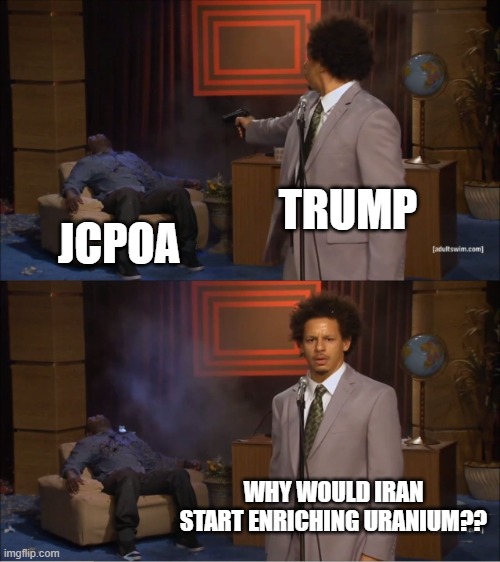
My summary of this the Nuclear Deal is the following: Obama’s Administration successfully negotiated, along with many other world powers, fair and equitable nuclear restrictions on Iran. Trump broke our end of the deal, which resulted in Iran breaking their end as well. To me, it looks like this:
Analysis of the Current State of Affairs
Now that we know the history of how we got here, and the details of the JCPOA, let’s analyze why Trump is now bombing Iran.
Let me be clear: Iran’s regime SUCKS. Amnesty International lists many, MANY human rights violations carried out on the orders of Ayatollah. In summary,
“Authorities further suppressed the rights to freedom of expression, association and peaceful assembly. Women and girls, LGBTI people, and ethnic and religious minorities experienced systemic discrimination and violence. Authorities intensified their crackdown on women who defied compulsory veiling laws, the Baha’i community, and Afghan refugees and migrants. Thousands were arbitrarily detained, interrogated, harassed and/or unjustly prosecuted for exercising their human rights. Trials remained systematically unfair. Enforced disappearances and torture and other ill-treatment were widespread and systematic. Cruel and inhuman punishments, including flogging and amputation, were implemented. The death penalty was used arbitrarily, disproportionately affecting ethnic minorities and migrants. Systemic impunity prevailed for past and ongoing crimes against humanity relating to prison massacres in 1988 and other crimes under international law.”
I, of course, want Iran to be a free country where people can live authentically and be safe in the streets. No doubt about that. However, Trump’s rhetoric about regime change is not something I believe is our responsibility or even something we can fix.
We already helped overthrow their regime once. It lasted ~20 years, and now it came back stronger and meaner. As we have seen in the past, War is never really waged as a humanitarian effort. It’s about resources – we want more, or want them to have less. In the current strike, a hospital and a school were bombed, killing 150+ civilians. Our methods of “bringing peace” are just killing more innocent people. There has to be a better way. Iranian extremists might continue to chant “Death to America”, but I can’t go a day without reading someone comment “Death to Democrats” about something here in the state.
If the real reason isn’t a humanitarian one, it’s nukes or other weapons. As we know having reviewed the JCPOA, we already had that issue under control and under monitoring. They did not break their end of the deal until we broke ours. This entire war could have been avoided if Trump didn’t feel the need to “try to do it better” than Obama and then fail miserably.
Notably, we also haven’t seen any retaliatory ground strikes here in the U.S. since Trump started the campaign. If they have ICBM’s, seems like they’d be using them after what we did to them.
Also important, WE GAVE THEM THE NUCLEAR TECH IN THE FIRST PLACE. We then gave them weapons to fight a battle for us while publicly calling them “the axis of terrorism”.
In the end, this is either a war or choice or a war that was completely avoidable. I know most Americans don’t support another endless war in the Middle East. Per Aljazeera, only 1/4 of Americans agree with what we are doing in Iran. Trump effectively started a war that the Americans don’t support and didn’t get Congressional approval before starting it. Can we PLEASE start the i-word process?
(That’s impeachment)
I hope this post gives you some backstory and understanding of what we are seeing here. In a future post, I’ll examine Netanyahu and Ayatollah to see which one has committed more atrocities. Foreshadowing: both are awful people.
Thanks for reading!


 Miss Information
Leave a comment