“Democrats are a scourge that should be eradicated, that would make America great!”
Conversely, “Republicans hate women, children, and anyone who doesn’t look like them or believe in the same God as them”.
Both of these sentiments are insanely common in today’s world.
Here’s a short expose of X posts about Democrats:
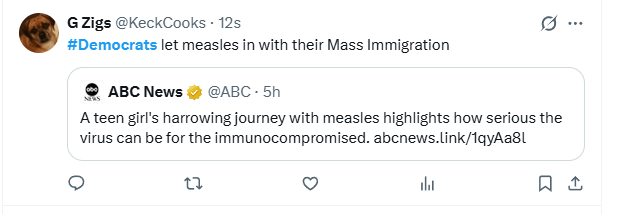
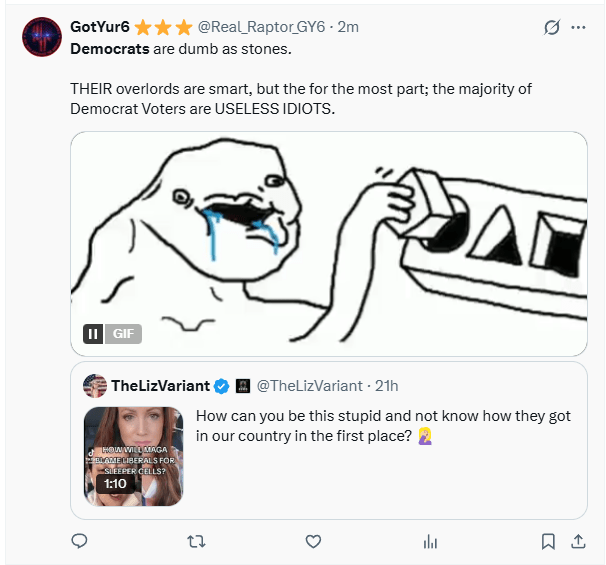
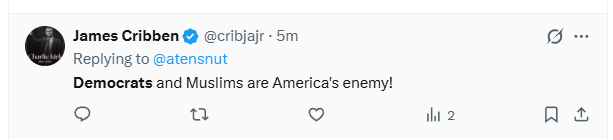
And the same from Bluesky about Republicans:


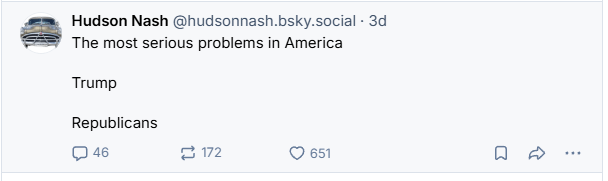

Clearly, there is a lot of animosity toward the opposing political group among Democrats and Republicans. Some of the animosity is earned, when directed at leadership on each side with extreme ideals. Most of it, when directed at the voters of each party, is a gross generalization about an entire half of the country feeling the exact same way.
Anytime language like “All Democrats…”, “All Republicans…”, and even down to “All Mexicans..”, “All Americans..” and “All women…” is incredibly problematic, because it’s implying that all groups don’t have good, bad, or ugly people as part of them. Take the recent attacks on Muslims. All but single-digit numbers of Muslims despise groups like ISIS, yet Congress is trying to pass laws that ban their religious freedoms because “All Muslims are terrorists”.
They’re obviously not, but rhetoric like this is intentionally inflammatory to make We the People hate They the Different Ones. I’m certain I’ve been guilty of buying in, as it’s so easy to. It’s in-group fighting just like we all remember seeing in grade school.
The divide between us is real and growing. The abolishment of the single opposing political party in the states would leave us incredibly vulnerable to authoritarianism from either side. How do we fix it?
Methods to Heal the Political Rift
Izzy Kalman wrote an article for Psychology Today in 2021 entitled, “How Psychology Can Heal the Political Rift” that breaks down his ideas on how to begin healing the rift between us. I’ll break down each point and then provide my feedback and experiences on it.
Appreciating Freedom of Speech
Kalman writes on this topic, “Like any other thing of value, freedom of speech (FOS) can be lost if we fail to appreciate it, which is precisely what has been resulting in recent years from psychology’s misguided campaign to protect people’s feelings. Thus, the ‘cancel culture’”.
I think cancel culture is a bit out of control, but in some cases I think it’s called for. If someone makes a statement like “black people are (insert racist diatribe here, I’m not even going to open myself to quotes taken out of context)”, then people have the right to be outraged. If someone simply says “I don’t support this political candidate because I think his policies will be too expensive”, no cancel should be called for. People are absolutely allowed to have opinions and voice them! If the same person said “I don’t support this political candidate because (insert racist diatribe here)”, that’s different.
Hate speech and free speech ARE different in my books. You can disagree with someone politically, regardless of their race, religion, etc, and as long as you don’t attack their race, religion, etc, that’s just fine.
We need to be tolerant of each other’s opinions, provided they aren’t rooted in hate. Stating facts itself is not racist, like “black people are more likely than their white peers to be on SNAP”. That’s a fact, and without any additional context it leads people to insert hate and say things about the work ethic of black people, without considering how black people have and historically have had less access to basic resources and high paying jobs than whites.
Next!
The vote is the great equalizer
“Equality is fundamental to a good society. There are many ways to exert political power, but for most of us it’s the vote. Democracy recognizes that citizens inevitably harbor conflicting political views, yet are still on the same side. Each of us believes our political approach is best for our mutual benefit. Who knows for sure who’s right? So, we vote to determine the way we go.”
Fair and secure elections ensure that we all have the chance to vote for the candidates that best support our ideals. In 2024, Trump was elected. I didn’t vote for him, but I understand why people did. They saw their interests protected, whatever those might be, and voted accordingly. Whether they still feel their interests are protected now, I’m not so sure. Regardless, we use our votes as our voice. Any attempt to make voting more difficult for anyone should be alarming to both sides, as it’s a fundamental requirement to make democracy work.
Be grateful for different political views
“So many of us with strong political opinions would like opposing voices to be silenced. Truth is, we would be miserable if only our political stance were permissible. We’d find ourselves in a totalitarian police state that punishes people for having the “wrong” view. Who can guarantee we wouldn’t be one of them. As much as we may despise the opposing political viewpoint, we should be grateful that people are free to voice it, as the alternative is incomparably worse”.
A-freaking-men! This is exactly why we need both sides. Extinguishing the flame of one whole political party would be lighting the fuse of extremism. We quite literally need each other for checks and balances to work.
Our favorite politicians are far less important than our friends, relatives, and neighbors
“To be successful, we need to make smart choices. Breaking off with good friends and relatives because they support the politicians we oppose is incredibly stupid. If you have a choice between a grant of one dollar or a thousand, there is no question which you would take. But when we give up a friend or relative over a politician, it is like choosing the dollar over the thousand. The politicians we vote for do not know or care about us personally. They will not dig out our car when it’s stuck in the snow. They will not invite us to their parties, unless they’re fundraisers. They will not help with housekeeping and childrearing, or give us a shoulder to cry on when we’re in the dumps. The only things of ours we can be certain they care about is our vote and contributions”.
I agree with this, to a point. That point is when their morals don’t align with mine, and I no longer want them to be associated with myself or my family. If I found out a dearly beloved friend supported pedophilia, I’d be quick to cut that tie. The same can be said for anyone who is racist, homophobic, xenophobic, etc. I’d certainly discuss it with them and see why they feel the way they do, and if it’s clear that it’s an ingrained belief and not a simple misunderstanding..I’m sorry, but we can’t be friends. I don’t want your ideals around my kids, because they are so misaligned with how I want to raise them.
That’s less about politics and more about morals, though. It wouldn’t matter to be if the hypothetical friend was democrat or republican – if they’re morally wrong, that’s all there is to it.
Our vote is important yet insignificant
“Elections are the essential mechanism of a government that represents the will of the people. We may be so passionate about our vote that we cast it as though we’re personally determining the course of the future. But we’re not. Our personal vote has virtually no effect on the election. It’s only the aggregate ballots of the thousands or millions of voters that matters.
The vote of our parents, spouse, children, siblings, friends, bosses, etc., is equally insignificant. It is pointless to be upset with them for voting for the candidate we hate. Appreciate that they have a right to vote for their preferred candidates, as stupid, incompetent, or evil as you may think they are, just as you have a right to vote for yours“.
Agreed, with the same caveat as the previous point. If they voted for a candidate because he’s pro-life and that’s their only issue, then I can’t be mad at them. If the same candidate is also vehemently racist and makes it clear that they intend to whitewash America, I have some questions. Like, a lot of questions.
This highlights a fundamental problem with our system – candidates must stick so close to the official narrative of their party, there’s no room for bipartisan ideals. Democrats who vote against Democrat initiatives are attacked, like Fetterman on the War Powers Resolution. I think his decision IS wrong for moral reasons, but if he’s representing his constituents that’s their will. Many voters are single issue voters, like many pro-lifers. They don’t even consider the other ideals of the candidate, they choose whoever is pro-life even if it might potentially disenfranchise them.
Mainstream media is an easy way to reach and influence these single-issue voters, as they can highlight only the portions of the candidate’s campaign promises and hide whatever they want behind the curtain. Maybe we need more voter education, less PAC money and accountability in the media.
Conclusion
To conclude, here is a promise to you, my readers. I will not silence you for not agreeing with my findings. As one reader said, two people can read the same facts and come up with wildly different conclusions. I will challenge you to defend your position with data and ask for evidence. If that evidence shows I’m wrong or missed something significant, I’ll adjust my opinion.
I hope that other people will follow suit. I think it would go a long way for Americans to start listening to each other and discussing their positions calmly, rather than resorting to playground insults and attacks.
Have a good weekend, ya’ll!
 Miss Information
Leave a comment