
“The left wants to allow abortions up to 28 days after the baby is born!!”
Abortion is a tough topic to talk about.
It’s emotionally charged. We are biologically programmed to love and protect our young, so it’s completely understandable that people will have big opinions on the subject. Without a doubt, this is the most difficult post I’ve written to date, simply because of all the research I read talking about pregnancy loss, babies born with horrific disabilities, and the like.
What I wanted to do it research how most pro-choice people view abortion. Do most people feel abortion is always an option, no matter the age and health of the fetus? Or is there more of a grey area?
My Personal Story and Opinion
I personally don’t think I could have an abortion of a child conceived without violence being involved. I have two of my own beautiful kids, and I can’t imagine making the choice to end the life of one of their siblings. That being said, 1) I have been married and monogamous for almost 9 years, 2) I could afford another kiddo and 3) I can afford genetic testing that would inform me of any potential disabilities my fetus may have.
Both my husband and I have birth control methods. I take the pill, mostly for PMDD reasons, and he got the ole’ snippy snip. If we were to get pregnant now, it’d be a damn miracle and I’d respect God’s will. 🙂 We will, however, do whatever we can to prevent one.
Between our two kids, we experienced two miscarriages. One at 9 weeks, then another at 5. The first had to be helped along with mifepristone. The second resulted in a missed miscarriage, forcing me to choose a D&C over the chance of sepsis. These are both forms of abortion care.
During my pregnancy with my second kiddo, I developed cholestasis and had to go in just about daily for fetal monitoring. Mila was born 4.5 weeks early, 1.5 weeks before our scheduled induction. Luckily, she didn’t need any NICU time, and I had received a steroid shot to help develop her lungs since I had been going in and out of labor for over a month. This experience made us decide that another baby isn’t in the cards for us, as cholestasis almost always impacts future pregnancies.
I wanted to share this information as it’s important to know I’ve had my own experiences with birth control and abortion care. With that background, I will look into the research of how people view abortion rights statistically.
Being Pro-Choice OR Pro-Life is a Sliding Scale
On one end of the spectrum, there are people who say abortion is NEVER permissible, regardless of the pregnancy’s potential outcome for the mother. If the delivery will kill the mom, people in the camp of extreme say “so be it”.
The other side of the spectrum is those who will advocate for infant euthanasia after birth when permissible disabilities exist. If you want to read research on this, it’s here. I read it and it made me feel sick. At the risk of being called woke – trigger warning.
Where do most Americans fall? Gallup research has some interesting insights. According to Gallup, circumstances are important when it comes to abortion.
The split of circumstances looks like this:
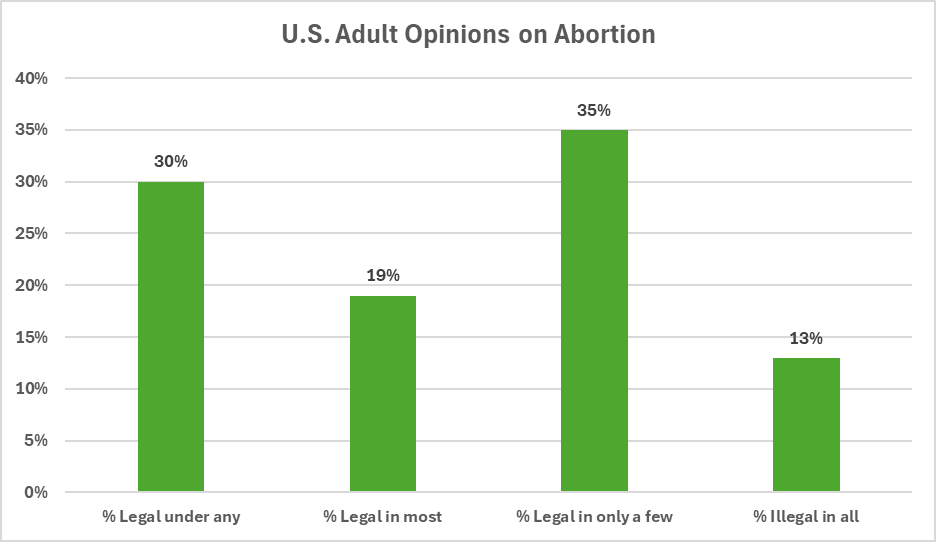
All but 13% of Americans agree that abortion should be legal in some circumstances. 30% of Americans think abortion should be legal ALL the time, whereas 54% see the legality is circumstantial.
The trimester also makes a difference for Americans. 69% of Americans supported abortion during the first trimester, whereas only 37% support in the second and 22% in the third. 59% of Americans disapprove of laws that ban abortions after a fetal heartbeat can be detected, usually around the sixth week of pregnancy.
So, there are the numbers. Americans as a majority support abortion in one situation or another, primarily if this happens in the first trimester.
Next question, what are the current routes for obtaining an abortion? What are the different flavors of laws out there?
Medical vs. In Clinic Abortions and State Laws
According to Planned Parenthood, the abortion pill (mifepristone or misoprostol) is only available until 77 days after the start of the woman’s last period. It is highly effective at ending pregnancies, even up to the cut-off number of days.
The alternative offered by Planned Parenthood is the in-clinic abortion. The length of time this choice is available is governed by state laws and by the clinic themselves. Some clinics will cut off before state laws mandate that they do.
According to AbortionFinder.org, laws break down like this:
- 13 states completely ban abortion
- 27 states ban abortion after a specified point in pregnancy
- 9 states require a person seeking an abortion to wait a specified period of time before their abortion
- 24 states require some type of parental involvement for a minor to get an abortion
Minnesota, the state where I live, allows abortions regardless of the length of the pregnancy, and does not require parental involvement for minors to get an abortion. Again, that’s what the state offers, not what clinics actually do. Planned Parenthood in St. Paul offers In-Clinic abortions up to 23 weeks and 5 days into the pregnancy.
Other states like Connecticut allows for abortions before the fetus would be viable outside the womb. Iowa and other states opt for a 6 week limit for legal abortion. As you can see, laws are all over the map!
Conclusion
Now for the part where I get to go off the rails and tell you my opinion.
I don’t support abortion without a clear medical reason past the first trimester. This is because it allows enough time for the family to get genetic testing to see if they have a healthy fetus, the fetus is not fully developed, and it is plenty of time for a young woman to decide if her pregnancy is right for her. If mom is in danger or the infant will not survive outside the womb, I support the rights of the parents to choose to have an abortion later than the first trimester. Those are the clear medical reasons I speak of!
That being said, it’s really not my business to tell another woman what she can and can’t do with her body. Having been through a pregnancy loss, I can tell you the decision to seek abortion care is not one that is undertaken lightly.
In addition, I think access to birth control is vital for preventing unplanned pregnancies where the mother may choose to abort her baby. If she has access to preventative medication, she’s more empowered to make her choices. Kids are gonna do what kids are gonna do, and I’m not naive enough to think abstinence works.
I hope it’s clear that not all pro-choice people are out there advocating for late term abortions. We as Americans mostly fall somewhere in the middle of the spectrum in a “yes, but…” situation.
Thanks for reading!


 Miss Information
Leave a comment