
“Islam is incompatible to life in the U.S. and must be stopped!”
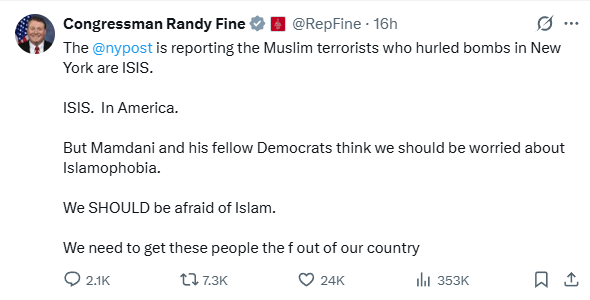
Islam and Muslims have been the target of a recent and growing trend in the US – Islamophobia. This isn’t just backwoods Hillbillies either, it’s being promoted in Congress:
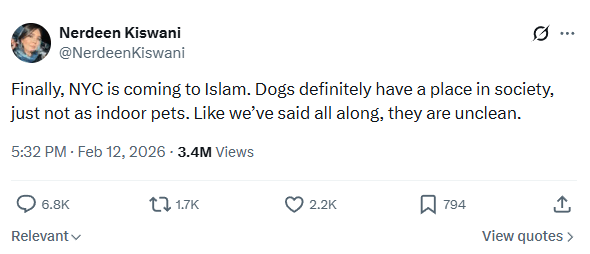
Muslims have also been in the news for hating on pet dogs, as one Muslim in NYC made an out of place comment about Americans keeping dogs as pets.
X user Nerdeen Kiswani posted:
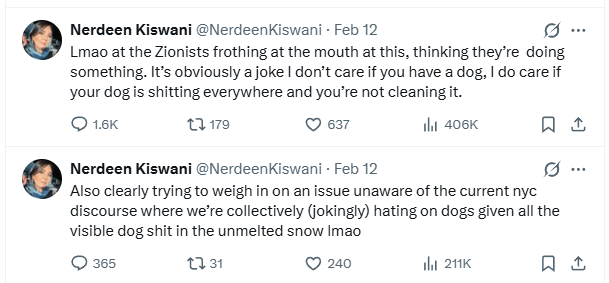
Followed by:
Fine weighed in:

All this, plus my own experiences browsing the unholy comment section of Conservative Islamophobic X posts, has inspired me to try to answer these questions:
- Is Islam truly a religion of violence because of Jihad?
- What are the core beliefs of Islam, compared to Christianity?
- What is Sharia Law and what does it require?
- Are Muslims trying to impose their religious beliefs on non-Muslims in a legal sense?
- Is there a correlation between any one religion and any specific type of crime?
Let’s start with questions 1-3.
What Exactly is Islam?
The year was 2012. I was a post-secondary student, meaning I was still a high school student but was taking college classes working toward completing my generals. Despite growing up Catholic and consequently being very uninterested in theological endeavors, I needed to pick an elective and chose World Religions as a throwaway course to check a box.
The class was actually fascinating. We learned how most of the world’s major religions mirror each other in creation story, core beliefs, and what they viewed as the afterlife. Norse mythology is an exception, as its creation story involves a cow licking ice and a giant suckling from her teats. You okay over there, Norway?
Islam was no exception. Having the framework of Catholicism (the Holy Trinity, Old and New Testament, the Ten Commandments, and so on), Islam was pretty easy to understand. Quick note: Islam refers to the religion; Muslim refers to the follower of Islam.
Here’s a brief history of the creation of Islam, from Britannica:
Islam was founded around the 7th century CE (meaning Common Era, or after Christ’s death) by the Prophet Muhammad. Islam was defined not only by religious beliefs but also by Islamic Law (which is not commonly referred to as Sharia Law). Like Christianity, Islam is monotheistic. Unlike the Christian belief that God is three people who are part of one entity (the Godhead idea), Islam believes in only ONE God: Allah. Britannica says this of Allah: “Although his presence is believed to be everywhere, he is not incarnated in anything. He is the sole creator and sustainer of the universe, wherein every creature bears witness to his unity and lordship. But he is also just and merciful: His justice ensures order in his creation, in which nothing is believed to be out of place, and his mercy is unbounded and encompasses everything. His creating and ordering the universe is viewed as the act of prime mercy for which all things sing his glories. The God of the Qur’an, described as majestic and sovereign, is also a personal God; he is viewed as being nearer to one than one’s own jugular vein, and, whenever a person in need or distress calls him, he responds. Above all, he is the God of guidance and shows everything, particularly humanity, the right way, ‘the straight path.’”
Allah created the Universe and everything in it, just as the Christian God did. Allah created man from clay and a separate race of beings called jinn from fire. Unlike God’s treatment of Adam, Allah forgave Adam of his disobedience instead of dooming him with original sin. Satan is a central figure in Islam, and the belief that he is a fallen angel persists in Islam. He is also seen as tempting humanity into sin.
The end of times is discussed in the Quran, and Muslims believe that “when the world will come to an end, the dead will be resurrected and a judgment will be pronounced on every person in accordance with his deeds.”
There are five key pillars of Islam — five things a Muslim must do to enter the afterlife with Allah. A sixth pillar was added later, which we’ll discuss when we get there.
Pillar One: Profession of Faith
The first pillar is the Profession of Faith. The actual profession is: “There is no deity but God, and Muhammad is the messenger of God.” This profession must be spoken aloud, correctly and purposefully, at least once in the follower’s lifetime. From this pillar come these beliefs:
- Angels (particularly Gabriel, the Angel of Inspiration)
- The revealed Book (the Qur’an and the sacred books of Judaism and Christianity)
- A series of prophets (among whom figures of Jewish and Christian tradition are particularly eminent, although it is believed that God has sent messengers to every nation)
- The Last Day (Day of Judgment)
Pillar Two: Prayer
Islam requires five daily prayers. The first prayer is performed before sunrise, the second just after noon, the third in the late afternoon, the fourth immediately after sunset, and the fifth before retiring to bed. Before a Muslim can pray, they are supposed to wash their hands, face, and feet.
Pillar Three: Alms
When Islamic religion and law were one and the same, there was a mandatory tax levied to the church for Muslims, equaling about 10% of their resources. Now that religion and law have diverged, charity is voluntary and it is up to the individual to decide how much to give. The exception to this is where Sharia law is still in place.
Pillar Four: Fasting
During Ramadan, fasting from daybreak to sunset is required, unless the individual is sick and unable to fast. This is seen as a sacrifice to Allah.
Pillar Five: Pilgrimage
Once during their lifetime, a Muslim must make a pilgrimage to Mecca — provided they can afford it and their family will not be burdened by it.
Not Pillar Six: Jihad
Jihad is something we all associate with the meaning “holy war.” This isn’t exactly what Jihad requires. Jihad literally means “struggle” or “fight.” According to EBSCO, “Interpretations of jihad vary widely among Muslims today. Many modern scholars and practitioners emphasize a peaceful understanding, viewing jihad primarily as an inner struggle to live a righteous life, engage in good deeds, and uphold moral values. This perspective highlights personal and communal efforts to improve oneself and society, often referred to as greater jihad, which includes striving for faith and preaching.”
Conversely, some Muslims do interpret it as a holy war. EBSCO writes, “Conversely, some Muslims interpret jihad as a call for holy war against nonbelievers and those perceived as threats to Islam, drawing from historical contexts and specific verses in the Quran. This view encompasses both defensive actions, which are permitted under certain conditions, and offensive jihad, which historically involved military conquests to expand the Islamic faith. The concept of jihad continues to be a subject of debate and differing beliefs within the Muslim community, reflecting a broader discourse on faith, morality, and conflict in the contemporary world. Understanding these diverse perspectives is essential for a nuanced view of jihad and its role in Islamic thought.”
When researching those who interpret Jihad as a holy war, it seems that most consider Jihad a defensive action — to protect their religion. The International Islamic Fiqh Academy (IIFA) says this of Defensive Jihad:
Defensive Jihad: which refers to the type of jihad dictated by the Sharia-based duty of defense when an attack is launched against religion, the Ummah, the country, the society, or the individual. The Sharia ruling justifying this type of jihad ceases to be valid as soon as the aggressive attack is over and the enemy moves outside the land. In this respect, Allah the Almighty said, “Fight in the cause of Allah those who fight you, but do not transgress limits, for Allah loveth not transgressors.” (Al-Baqarah, 190)
And this of Offensive Jihad:
The ultimate objective of “Offensive Jihad” is the communication of the message of Islam without compulsion, because Allah the Almighty said, “Let there be no compulsion in religion.” (Al-Baqarah, 256); “…the Apostle’s duty is only to preach the clear message.” (Al-Nur, 54); and “…thy duty is but to convey the message.” (Al-Shura, 48) In this type of Jihad, and under contemporary circumstances, preachers should make use of international conventions and treaties which have made the world a territory of ‘ahd (covenant) in which countries allow mobility and grant freedom of missionary work through various modern devices of communication, in different languages, and among different societies.
From this, I see no “Go out and murder in the name of Allah!” I see “Defend your religion if you need to, but stop once the invader is no longer a threat,” and “You have the right to act as a missionary and attempt to spread the word of Allah.”
Of course, as with anything that leaves room for interpretation, extremists do bend the words of Allah to justify violence. I’ll look at a recent story in the news later in this article that I feel is an example of Jihad being misused.
Now that we understand the core pillars and beliefs of Islam, let’s look at the split between Islam the religion and Sharia Law..
Islam as a Religion vs. Sharia as a Law System
Sharia Law is by and large the biggest driver of Islamophobia here in the US. Sharia Law, at its core, is a religious code of behavior for Muslims to live by, covering moral, legal, and spiritual topics. Sharia can either be used as a personal guideline for Muslims or, in some cases, a complete legal system as it is used in Saudi Arabia and Iran.
Sharia, like the concept of Jihad, is open to interpretation. It can be interpreted in a positive light to guide a Muslim’s choices toward morally correct ones, or it can be interpreted to justify murdering gay people and stripping away women’s rights.
Now is a good time to introduce the different schools of Islam, as they weigh in differently on Sharia. Just as there are Evangelical, Methodist, Lutheran, Baptist, and Catholic Christians, there are different interpretations of Islam. The two remaining core schools of Islam are Sunni and Shia. Here is a table of their beliefs, derived from a European Parliament Briefing:
| Tenant | Sunni | Shia |
|---|---|---|
| Legitimate caliphs | First four caliphs | Ali and his descendants only |
| Leadership infallibility | No | Yes (most branches) |
| Central authority | No | More hierarchical |
| Size today | ~87–90% of Muslims | ~10–13% |
The main differences, seen here, are that Sunni Muslims do not believe their leadership to be infallible and do not believe in a centralized authority, whereas Shia Muslims believe both to be true. You can already see how an infallible leader in a centralized position can lead to bad things happening.
Here is where Sharia stands on some of the hot topics, according to the Council on Foreign Relations (CFR):
Corporal Punishment: Sharia allows for some pretty awful punishments, like stoning, lashing, and amputation. However, applying such punishments requires meeting extensive evidentiary thresholds, so scholars say they are largely meant to serve as a deterrent rather than have a punitive effect through application. Most Muslim-majority countries do not employ these physical punishments despite having legal authority to do so. Iran, a Shia-run country, has in recent years ordered flogging and amputations.
Jihad: Sharia describes Jihad as the effort to achieve a moral aim, which could be an armed struggle against injustice, the desire to better oneself morally, or the pursuit of knowledge, for example. Importantly, it does not advocate for killing all non-Muslims.
Religious Tolerance: Muslim-run countries discriminate against other religions to varying degrees; in some countries, blasphemy against Allah is considered a crime, and in others like Saudi Arabia, only mosques can be built — no other places of worship.
Democracy: Different opinions exist in Muslim-run countries on democracy as a concept. Sharia doesn’t specify a system of government — some people see democracy as a Western system and reject it, while others say it is called for in the Quran in the form of “mutual consultation.”
Women’s Rights: The Quran states that women are morally and spiritually equal to men but also indicates that wives and mothers have specific roles in the family and society. Certain Sharia guidance applies specifically to women, and some governments use Islamic law to significantly restrict women’s rights, dictating how they dress and barring them from or segregating them in certain spaces.
LGBTQ+ Rights: All major schools of Islamic thought say that practicing homosexuality is a sin (even though same-sex attraction has long been accepted), and laws in most Muslim-majority countries discriminate against LGBTQ+ people. In the extreme, same-sex behavior is punishable by death under Islamic law in ten countries. In others, it is often harshly punished, as it is in some more conservative Christian-majority countries.
So in short, Sharia law, when implemented as an end-all-be-all legal system, is definitely problematic. It’s not Sharia law itself that is the issue — it’s the way that the people in charge interpret it and bend things to suit their will. I would agree that Sharia law has no place replacing or directly influencing our legal system — just as I believe there should be a separation of Church and State for all religions. LGBTQ+ and women’s rights should not be legally defined by a religious belief. People should still be free to believe what they believe, provided they don’t use those beliefs to harm others or strip away their rights.
So, there are questions 1–3. To recap:
Is Islam truly a religion of violence because of Jihad? No, Jihad does not directly call for violence. It calls for defending one’s religion from attackers and allows for the rights of Muslims to preach their beliefs. It also stands for the struggle against temptation — an internal war to live morally.
What are the core beliefs of Islam, compared to Christianity? They are extremely similar. Islam is a God-based religion with pillars that align with what I learned in Catholic school.
What is Sharia Law and what does it require? Sharia law is a moral code that is often adopted as a legal system in Muslim-run countries. It’s open to interpretation, meaning it can be used to justify atrocities. Mostly, it’s used to guide moral and spiritual decisions.
Sharia in America
I’m just going to come right out and say it: no Muslim has ever tried to introduce legislation to make America a Sharia country.
In a 2011 study, the ACLU examined cases where Muslims attempted to use their religious beliefs for their benefit. In all cases, the U.S. legal system worked as intended. To put it shortly, they state, “Our legal system has built-in protections to ensure that courts do not improperly apply foreign, international, or religious law.” 2011 was, of course, 15 years ago, but our legal system has not changed.
Overall, the ACLU concludes:
When the court cases cited by anti-Muslim groups are examined more closely, the myth of the “Sharia threat” to our judicial system quickly disappears. Far from confirming some fabricated conspiracy, these cases illustrate that our judicial system is alive and well, and in no danger of being co-opted or taken over by Islam.
You can read the study here for a full understanding: ACLU Study.
Question 4 recap:
Are Muslims trying to impose their religious beliefs on non-Muslims in a legal sense? Not in any meaningful way, and when they do, the U.S. legal system prevails against religious law.
Violence Isn’t a Muslim Problem
With the understanding that Jihad doesn’t mean “go kill everyone,” and that the core pillars in no way advocate for violence, I think it’s safe to assume that when Muslims commit violence, it’s because they as individuals chose to interpret their religion in that way.
In an article titled “Killing in the Name of God: The Problem with Holy War,” Dr. David L. Perry concluded that all major religions have specific passages that have been used to justify mass murder. Here is a condensed version of his examination of the three Abrahamic religions:
Perry argues that all three Abrahamic traditions contain internal tensions — passages promoting peace alongside ones that have been used to justify violence:
- In the Hebrew Bible, collective punishment and indiscriminate war were commanded in cases of idolatry, leading to justifications for the slaughter of entire communities.
- In Islam, the Qur’an contains both statements against compulsion in religion and passages that were used to justify offensive jihad to expand the territory of Islam. Traditional Islamic law did not establish a blanket principle of noncombatant immunity, though many Muslim leaders uphold such a principle today.
- In Christianity, early Christians were largely pacifist, but a major shift occurred in the 4th century under Emperor Constantine. Later, popes declared that killing unbelievers was spiritually beneficial, culminating in the Crusades, where killing Muslims became a form of penance and moral rules governing war were abandoned entirely.
Perry then advocates for confronting these issues directly. He offers three theological recommendations: hold firmly to the belief that God is compassionate and just; abandon the idea that God ever commanded the mass slaughter of innocent people, even if such claims appear in scripture; and consider that God’s actions being limited by objective moral principles does not diminish God’s power.
TL;DR: Stop using God’s name to justify killing people, because that’s not what God is about and not what he advocates for.
Here are two recent cases of Muslim violence in the US:
Texas Mass Shooter, Ndiaga Diagne
Explosives Thrown at Stop the Islamic Takeover of New York City Protest
In the first case, the shooter acted alone. This was not a sponsored activity nor was it condoned by any Islamic leadership. It was, like all mass shootings, just one or more lunatics with a gun.
The second was an outright protest against Muslims’ rights to exist in NYC, and the attacks were linked to ISIS. ISIS is a terrorist group that happens to be Islamic. Once again, Muslim leadership does not condone the activity of extremist factions.
Now, two cases of recent attacks against Muslims in the US:
The Fatal Shooting of Mellisa and Mark Hortman
Youth Pastor Arrested for Child Sex Crimes
Lance Boelter, the murderer of Mellisa and Mark Hortman, was a devout Christian who advocated for violence in the name of God.
Mikah Brondyke, the youth pastor, was charged “with several child sex crimes, including disseminating obscenity, soliciting a child, indecent liberties with a child, and first-degree sexual exploitation of a minor.” This devout Christian used his position of power over the children he was supposed to teach in order to exploit them. Unfortunately, Brondyke’s case is not unique. Google it if you feel like getting sick to your stomach today.
With that, a recap of question 5:
Is there a correlation between any one religion and any specific type of crime? Not in the U.S. Abroad, Sharia law has been used to justify horrendous campaigns against women, gay people, and non-Muslims. This is due to the interpretation of Muslim leaders and a centralized, infallible authority, not due to the religion’s teachings. Christians, Jews, and Muslims are all capable of committing atrocities, and if they choose to bend their religion to support it, they all can and do. The problem is with the individual, not the religion.
Conclusion
Damn, I can’t wait to take all this new information to argue with Islamophobes on social media! I feel confident that there is no Islam “problem” in the US, and that Islam does not call for or advocate violence. Muslims misuse the Word, just like Jim Jones misused the Word of God to justify the Peoples Temple. The religion isn’t the problem – the extremists are. Muslims are not coming for your dogs, and even if they were, the US legal system would do its thing.
Thanks for reading!


 Miss Information
Leave a comment